You may wonder how do noise cancelling headphones work, and why a plane’s engine hum fades. Microphones listen to the noise, and a chip plays an opposite sound that cancels it.
| Item | Value |
|---|---|
| Core method | Phase-flipped “anti-noise” mixed with your music |
| Feedforward microphone position | Outside the ear cup |
| Feedback microphone position | Inside the ear cup |
| Timing tolerance | A fraction of a millisecond |
| First commercial pilot headsets (Bose) | 1989 |
Figures come from freeCodeCamp and TechRadar. Products change, so check the sources before you rely on them.
The basic idea: sound that cancels sound
Sound travels as a pressure wave. If you add a second wave that is the exact mirror image, the peaks of one line up with the troughs of the other, and the two flatten out.
That is active noise cancelling (ANC). TechRadar explains that ANC uses microphone measurements to generate a cancelling signal, which the drivers reproduce alongside your audio.
The result is not a silent room. It is a quieter spot at your eardrum, because the cancelling only works where the two waves meet.
The loop inside the earcup
Everything happens in a fast loop. A typical chain looks like this:
- A microphone picks up the sound around you.
- The signal is converted to digital form and analysed by a small processor.
- The processor builds an inverted copy of the noise.
- The driver plays that copy alongside your music.
- The noise and anti-noise meet at your ear and largely cancel.
Timing is the hard part. As freeCodeCamp puts it, “If the anti-noise arrives even a fraction of a millisecond too late, it can’t cancel the original wave effectively.”
TechRadar adds that it takes time for the microphone’s signal to be analysed, converted and sent to your ears. That is why designers work hard to keep processing delay tiny.
Feedforward, feedback and hybrid designs
Makers place microphones in different spots, and the choice changes how the system behaves.
- Feedforward: the microphone sits on the outside of the ear cup, so it hears noise before it reaches your ear.
- Feedback: a microphone within the cup monitors the remaining sound after ANC has acted.
- Hybrid: microphones outside and inside the cup help the system anticipate incoming noise and monitor the cancellation result.
As freeCodeCamp explains, feedback ANC responds to noise measured inside the cup rather than detecting it before arrival. Feedforward can react earlier but cannot check the final result at your ear.
That trade-off is why many current models use the hybrid approach. It is also why a product page that says only “ANC” tells you little about the design.
Why some sounds fade and others do not
ANC does best with steady, low-pitched noise. As freeCodeCamp explains, the longer cycles of low-frequency noise give ANC more time to respond.
A slowly changing wave is easier to predict and mirror in time. ANC is generally less effective against sudden sounds and voices than steady low-frequency noise.
TechRadar notes that differences between the sound at the microphones and at your ears limit cancellation accuracy. Expect a big drop in drone, and only a small one in sharp, unpredictable sounds.
Passive isolation also matters
Electronics are only part of the story. TechRadar notes that most ANC designs also block noise physically through their enclosed construction and sealing tips or cushions.
freeCodeCamp makes the same point: passive isolation relies on physical barriers, such as dense ear cups, tight acoustic seals and foam ear tips, and it does not generate an anti-noise signal.
This matters when you shop. A poor seal lets noise leak around the cushion, and the electronics cannot fully make up for it. Fit differs between in-ear vs over-ear headphones, and between small buds, so try several ear tip sizes if you can.
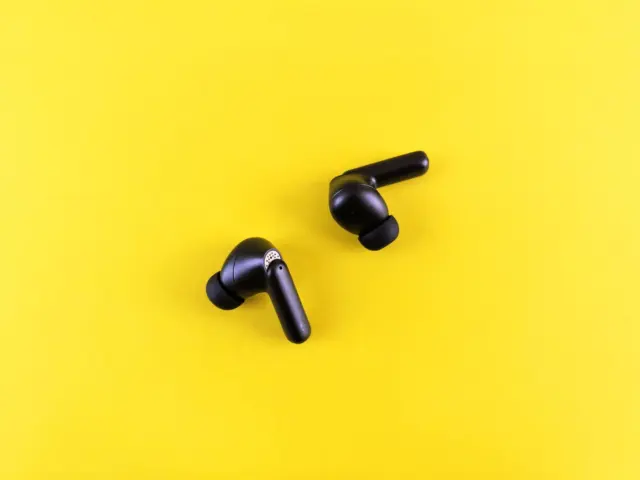
If you are still choosing a style, our guide to types of headphones covers the main options. Small true wireless earbuds are a good example of ANC squeezed into a tiny body, where the seal in your ear canal does a lot of the work.
How do noise cancelling headphones work in daily use?
In practice, you switch ANC on and the microphones start sampling at once. The processor never stops adjusting, because the noise around you keeps changing as a train speeds up or a fan cycles.
That constant adjustment is why ANC feels strongest on a long, steady journey. On a quiet street with sudden footsteps and voices, the effect feels smaller, because those sounds change faster than the loop can follow.
Here is what to expect in common settings:
- Planes and trains: steady engine and track rumble is the ideal target, so the improvement is easy to hear.
- Offices: ventilation hum fades, but nearby speech still comes through.
- Streets: traffic drone may drop, but do not rely on hearing horns or sirens while wearing headphones.
Many models add a transparency mode, which does the reverse: it passes outside sound through the microphones so you can hear announcements without removing the headphones.
Getting the most from ANC
A few simple habits help the system do its job, since the electronics and the physical fit work as a pair.
- Choose the ear tip or cushion that seals best, because a leak lets in the sound the microphones are trying to cancel.
- Keep the microphone ports clean, since a blocked port gives the processor a poor picture of the noise.
- Check the fit while wearing the headphones, since a good seal helps reduce incoming noise.
None of this changes the physics. ANC reduces sound near your ear, and it works best when the passive seal has already done the heavy lifting.
Common myths about ANC
Several ideas about noise cancelling are wrong, and they lead to disappointment in the shop or on the plane.
- Myth: it creates silence. It lowers steady noise near your ear. It does not remove sound from the room.
- Myth: more microphones always means better. Placement and tuning matter as much as the count, and a good seal still counts.
- Myth: it replaces passive isolation. The two work together, and the passive part handles what the electronics cannot predict.
Knowing this helps you read reviews. A model that scores well on a steady drone may do little for speech, and that is normal for the technology, not a defect.
A short history
The idea is older than most buyers realise. According to TechRadar, pilots got their hands on Bose’s first commercial take on the technology in 1989.
Aircraft cabins were the obvious first use. Engine rumble is steady and low in pitch, which is exactly what ANC handles best.
Frequently asked questions
Do noise cancelling headphones block all sound?
Show answer
No. They reduce steady, low-pitched noise well, but sudden sounds and voices still get through. Passive isolation from a good seal handles much of the rest.
Why does ANC need microphones?
Show answer
The processor can only build anti-noise from what it measures. Microphones outside the cup, inside it, or both, supply that signal.
Does ANC use the music I am playing?
Show answer
The anti-noise is mixed with your music and played through the same drivers, according to TechRadar. The system aims to cancel the noise and leave your music alone.
Is hybrid ANC better than feedforward or feedback alone?
Show answer
It combines prediction from the outside microphone with correction from the inside one, so it can cover the weak points of each. Real results still depend on tuning and fit.