
Wondering if bone conduction headphones really play music through your skull? They do: small transducers vibrate against your cheekbones, and your inner ear picks up those vibrations while your ear canals stay open.
This guide sits within our wider look at wearable audio.
| Item | Value |
|---|---|
| Bone that carries the vibrations | Temporal bone, at the sides and base of the skull |
| Inner-ear structure that receives them | Basilar membrane inside the fluid-filled cochlea |
| Sensory cells in the organ of Corti | 15,000 – 20,000 |
| Model of bone conduction published | 2014 (Imperial College London and Max Planck researchers) |
| Bone-conduction wearables cited by researchers | Google Glass |
These figures come from Imperial College London’s news release and the Max Planck Society’s summary. Research evolves, so check the sources before you rely on them.
What bone conduction actually means
Normally, sound travels as air pressure waves into your ear canal, hits the eardrum and moves tiny bones in the middle ear. That motion ends up in the inner ear, where the signal is turned into nerve impulses.
Bone conduction skips the first part of that route. Researchers describe a second pathway, one that relies on sound being conducted through bones in the skull.
The idea is not exotic. Your own voice reaches you partly through your skull, which is one reason a recording of yourself sounds strange.
How vibrations travel from cheekbone to cochlea
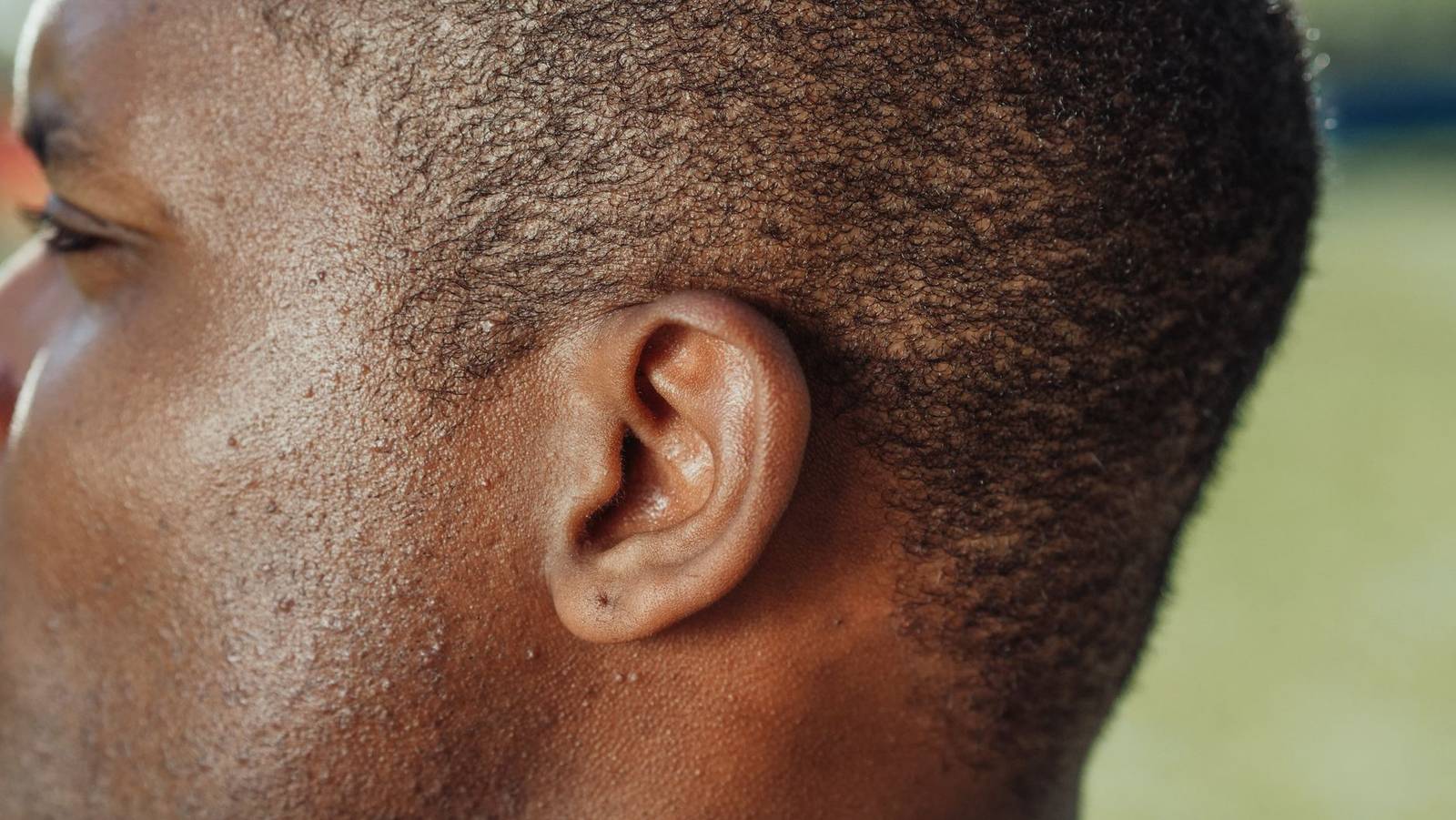
The headphone’s transducer rubs a tiny vibration into the skin and bone just in front of your ear. According to Imperial’s description, sound transmitted as vibrations through the skull travels to the temporal bone, found at the sides and base of the skull.
From there the path is the same one air-borne sound ends up using:
- The transducer vibrates against the cheek or temple.
- The vibration spreads through the skull to the temporal bone.
- The bone around the inner ear passes the motion to the fluid-filled cochlea.
- The basilar membrane moves, and hair bundles on sensory cells detect it.
- Your hearing nerve sends the signal to your brain.
The Max Planck summary describes vibration in the bone surrounding the inner ear. Their model describes the movement of that bone and the basilar membrane as coupled.
What the research says about the inner ear
Until fairly recently the details were murky. The Imperial team said that bone conduction had been poorly understood, and that a new model more clearly explains how it works.
Supported by the basilar membrane, the organ of Corti contains 15,000 – 20,000 specialized sensory cells, according to Imperial. Their hair bundles respond to fluid movement within the cochlea. Those cells do not care much whether the fluid was set moving by air or by bone.
The model was described in a 2014 paper on a cochlear-bone wave. The researchers suggested better understanding could help manufacturers deliver higher quality sound.
Why people choose bone conduction headphones
The main draw is that nothing sits in or over your ears. You can hear traffic, colleagues or a bike behind you while music plays.
- Awareness: ambient sound still reaches your ear canals.
- Comfort: no ear-canal pressure or sealed feeling.
- Glasses and hats: the band rests behind the head, so little gets in the way.
That design overlaps with the wider group covered in open ear headphones, though not all open-ear products use bone at all. Some simply aim small speakers at the canal.
Limits and honest trade-offs
Bone conduction is not a free pass for loud listening. The inner ear receives the vibrations either way, so high volume for long periods can still strain it. Treat any volume setting that makes conversation hard to hear as too loud.
Sound quality is another trade-off. Bass can feel buzzy on the cheeks, and in noisy places you may be tempted to turn the volume up. Sound leakage varies by model and listening volume.
Anyone with tinnitus, hearing aids or a diagnosed ear condition should talk to an audiologist rather than assume bone conduction is gentler. Hearing professionals use bone-conduction devices for particular kinds of hearing loss, but a general consumer product is not a treatment.
If immersive effects matter to you, our piece on spatial audio explained covers how directional sound works.
Where the technology came from
Bone conduction was used in hearing devices long before it reached fitness gear. Clinicians use it for people whose outer or middle ear does not pass sound well, because the vibration can go around the blockage.
Consumer products borrow the same principle for people with typical hearing. The goal is different: not to restore hearing, but to keep your ears free while you listen.
Researchers have also pointed to wearables as a growing use. Imperial’s release mentioned Google Glass as one example of companies sending sound to the brain this way.
That interest is a reason the science matters. A clearer model of how bone and basilar membrane move together gives engineers a better target when they tune transducers, pad shapes and frequency response.
What is inside the hardware
A typical pair has a band that wraps behind your head and two small pads that rest just in front of your ears. Inside each pad sits a transducer, a part that turns an electrical audio signal into a controlled mechanical shake.
Everything else looks like a normal wireless headset. There is a battery, a Bluetooth chip, a microphone for calls and buttons for volume and playback.
The band matters more than it looks. It sets how firmly the pads press on your face, and that pressure changes how well the vibration couples into bone.
Bone conduction compared with other ways of listening
Here are the practical differences between three common styles. They describe general design traits, not any one product.
- Bone conduction: vibration through cheekbone and skull, with the ear canal left open.
- Open-ear speakers: air-borne sound aimed at the canal, which also stays open.
- In-ear or over-ear: air-borne sound through a sealed or covered ear, so the canal is blocked or covered.
Sealed designs usually give fuller bass and block more outside noise. Bone conduction trades some of that richness for awareness of your surroundings.
Choosing and using a pair sensibly
Match the product to how you will use it. A pair meant for runners suits outdoor exercise, while a desk worker may care more about call quality and comfort over a long day.
- Fit: try to check that the band does not pinch around your head or glasses.
- Volume habits: keep it low enough to hear a nearby voice.
- Environment: in loud places, consider a different style instead of raising the volume.
- Breaks: give your ears regular rests from any headphones.
If something feels off, such as ringing, muffled hearing or discomfort, stop listening and speak to a hearing professional. This site is an independent educational resource and does not give medical advice.
Frequently asked questions
Do bone conduction headphones go through the eardrum?
Show answer
They mostly bypass it. Vibrations travel through the skull bone to the cochlea, though air-borne sound from the transducer can still reach your ear a little.
Can they protect my hearing?
Show answer
Not by themselves. They keep your ears open, but the inner ear still receives the vibrations, so volume and listening time still matter.
Why do they tickle at high volume?
Show answer
The transducers physically vibrate the skin and bone. At high levels you feel that motion as a buzz on your cheeks.
Do they work for everyone?
Show answer
Not necessarily. Results vary with the type of hearing loss, so ask an audiologist if you have any ear condition.